

Which indoor golf simulator actually keeps you practicing?
The best-in-breed home setup is also the easiest one to install and the friendliest one to a brand-new golfer. Completeness — not complexity — is the difference between a studio you grow into and one that gathers dust.
Conscious Golfer | Golf Simulators
The honest test for any home golf simulator is not how it performs on day one. It is whether you are still walking into the room a year later. The market is full of impressive components —high-end radars, beautifully rendered courses, premium screens — but most home builds get abandoned within a single season. The reason is almost never the technology. It is the friction.
Friction looks like this. The launch monitor needs calibration every time you set up. The projector throws to a screen it was not optimized for. The enclosure is a Frankenstein of parts from three different vendors, and when something goes wrong you spend an evening on the phone trying to
figure out which company owns the problem. You skip practice once. Then twice. By month four, the room is storage.
Completeness is the cure. The question worth asking before you write a check is whether the simulator you are buying was designed as a single system — or assembled as a list of compatible parts.
What “complete” actually means
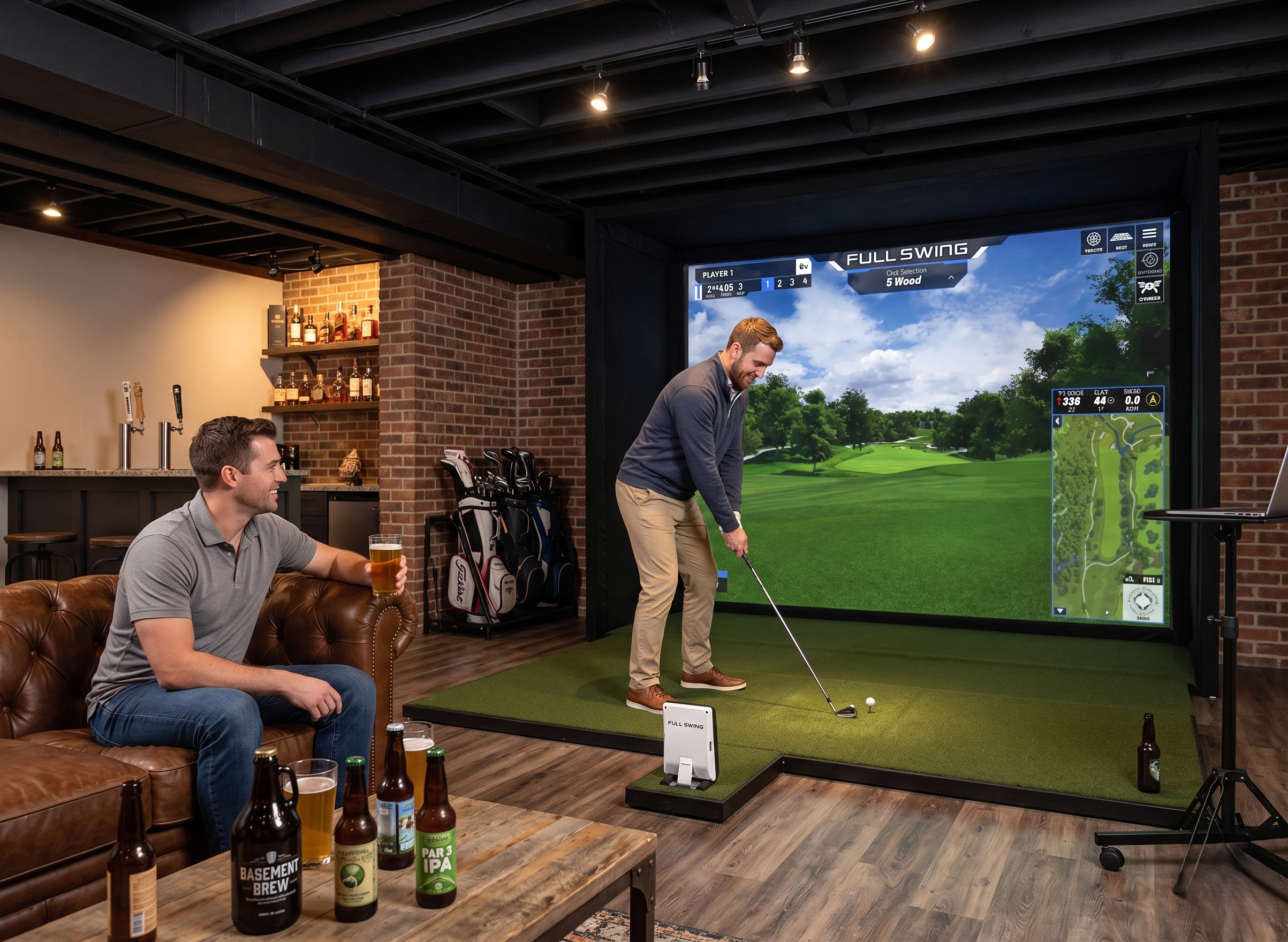
A complete studio system arrives with the components specified to work together: launch monitor, enclosure frame, impact screen, side barriers, premium projector, hitting mat, turf landing pads, and the cabling to connect all of it. The Full Swing Studio package is built this way. The enclosure uses a color-coded framing system with quick-connect buttons so installation takes minutes, not a weekend. The projector is matched to the screen. The mats and landing pads are sized to the footprint. You unpack it, build it once, and it works.
The setup demands a reasonable but not extraordinary room — a minimum nine-foot ceiling, twelve feet of width, and eighteen feet of length. That is a finished basement, a converted garage, or a dedicated room above a garage. The standard package fits the spaces most homeowners already have. You do not need a purpose-built studio or any prior simulator experience to install it.
This kind of integration is what separates a system you use from a system you maintain. Everything in the box was tested with everything else in the box. That sounds like a small thing.
Over five years of ownership it is the entire difference — and on day one it is the difference between a working studio by dinner and a half-built project in the corner.
The portable launch monitor is the part most buyers miss
The Full Swing KIT — the launch monitor at the center of the Studio package — is also fully portable. It packs into an included padded case and goes with you. To the range to verify dispersion. To the course on a Saturday morning to dial in wedge yardages on the practice tee. To a friend’s backyard for a long-drive contest. To a tournament site for warmup.
This is the feature that quietly determines whether you keep practicing. Most home simulators work as a single-location tool. Your practice exists in one room or it does not exist at all. The KIT changes that math. The same device that tracks your sessions indoors is the device that confirms what you actually do outdoors on grass and wind. Your data set is continuous instead of fragmented.
The technology behind it is best-in-class. The KIT uses a 5D AI Micro-Doppler radar to produce sixteen data points per shot — carry, total, spin rate, spin axis, face angle, face-to-path, attack angle, launch angle, ball speed, club speed, smash factor, club path, horizontal angle, apex height, side carry, and side total. A 4K camera records swing video synced to the shot. A full-color OLED display surfaces the metrics that matter at a glance. The accuracy is the same accuracy a PGA Tour player gets on the practice tee. What changes from player to player is how much of the data you choose to look at.
Built for the first swing as much as the championship round
One of the quiet strengths of a well-designed simulator is that the same machine teaches every level of player. A brand-new golfer does not need to read all sixteen metrics. Three of them — smash factor, ball speed, and face angle — are enough to learn what a solid strike actually feels like, and that feedback is the fastest path out of the frustrating early months. The KIT’s on-screen display can be simplified to surface exactly that.
An intermediate player working toward a single-digit handicap can lean on dispersion patterns, gap distances, and spin axis to find the leaks that cost three or four shots a round. A competitive amateur or club professional can dial in spin loft, attack angle, and shot shape with the same precision the touring pros use. One studio, the same data, different stories at different stages of a golfer’s development. You grow into it; you do not outgrow it.
Course-play software bundled with the system widens the experience further. You can play famous courses, run skills challenges, host friends, or set up a structured practice block. The barrier to a useful session is low enough that a beginner will actually use it, and the ceiling is high enough that a scratch player still finds value in it five years in.
Pedigree that matters
Tiger Woods has used Full Swing simulator technology at home since 2015 and relies on the KIT for his own preparation. Jon Rahm uses it too. None of that makes the system aimed only at advanced players — the opposite is true. What it means is that the tool you set up in your basement was validated at the highest level of the game before it ever arrived in a consumer box. That is the rare case where the same product genuinely serves a first-time golfer and a major champion.
Why this connects to Droemer’s week at Bandon Dunes
Jesse Droemer, a PGA teaching professional out of Riverbend Country Club in Sugar Land, Texas, just won the 2026 PGA Professional Championship at Bandon Dunes — a brutal, wind-blown 312-player field — by a single stroke. He posted four-under 283 and earned the Walter Hagen Cup along with a spot in the PGA Championship at Aronimink, his third major appearance.
What is worth noticing is the kind of practice that produces a result like that. Club professionals do not have unlimited tour-prep schedules. They do not get warm winter ranges or full coaching teams. They squeeze repetition into early mornings, between lessons, and after the shop closes. The players who succeed at the highest level are the ones who built a practice habit that survives the calendar.
A complete, dialed-in simulator setup is one of the most effective tools available for that kind of disciplined, year-round work — and the same daily, low-friction rhythm is exactly what helps a brand-new golfer build a swing in the first place. The studio works the same way whether your goal is breaking 100, qualifying for a club championship, or simply enjoying a Tuesday night round with friends from your basement. Droemer’s week at Bandon is a reminder that consistent practice, not occasional access, is what builds a game at any level.
The Conscious Golfer take
Buy once, complete. A piecemeal home simulator costs less on the receipt and far more in time, frustration, and abandoned afternoons. A fully specified Studio package with a portable launch monitor at its core is the version that earns its footprint — the room stays a practice room, and the data follows you out the door. Best-in-breed technology, a setup almost anyone can install in an afternoon, and a tool that meets you wherever you are in the game.
That is the simulator that actually keeps you practicing — whether this is your first season or your fortieth
Consider every practice session with your indoor simulator as a chapter in your personal story of mastery. Allow each swing and putt to become part of an unfolding tapestry of skill and self-discovery. Your journey is your own, and a conduit for intentional living and wellbeing is truly at your fingertips.
For further inspiration on mastering your thinking or enhancing your wellness routine, explore more through these carefully curated articles that align with the Conscious Golfer ethos.