
How to Evaluate Total Cost of Ownership on an Electric Golf Cart
The math that almost no dealership puts in front of you — and why it reveals where the real value of an electric golf cart actually lives.
Conscious Golfer | E-Golf Carts
Embrace the Long View
Intentional ownership is not only about the moment of purchase; it is about the discipline to see past the first number on the page. As Conscious Golfer advocates for mindfulness and stewardship in every choice, we extend the same practice to the way we measure value. The right number is total cost of ownership, or TCO. It is what the cart will actually cost you over the years you plan to own it, once you account for batteries, maintenance, electricity, tires, insurance, depreciation, incentives, and resale value. Across a fifteen-year window, a well-built lithium cart delivers substantial savings — and those savings show up in places most buyers never think to add. Here is how to think about it.
The battery is the largest variable
A traditional lead-acid pack in a daily-use cart lasts three to five years before it needs replacement. Replacement cost runs anywhere from $1,200 to $2,000 depending on configuration. Over a fifteen-year ownership horizon, that is three to four battery replacements, totaling $4,500 to $8,000 just to keep the cart moving. A quality lithium pack carries a five-year warranty as the popular configuration, while real-world cycle life frequently reaches ten to thirteen years. In most ownership scenarios you replace it once across a fifteen-year window — or not at all. That alone keeps thousands of dollars in your pocket before any other line item enters the conversation. For an in-depth guide, check out The Lithium Battery Buyer's Checklist.
Maintenance is the quiet line item
Lithium carts have fewer wear points. They do not require watering, voltage testing, or terminal cleaning the way lead-acid packs do. Regenerative braking reduces brake wear. Lower vehicle weight reduces tire and suspension wear. Bearing and motor service intervals are longer because there is less mechanical strain on the drivetrain. A realistic maintenance budget for a lithium cart is $150 to $300 per year for routine items: tires every four to six years, brake pads every five to seven years, occasional fluid and bearing service. Lead-acid carts run roughly double that, and the work happens on a more demanding schedule. Electricity is small but worth measuring Charging a typical electric golf cart costs roughly $0.40 to $0.80 per full charge depending on local utility rates. Even with daily use, you are looking at $150 to $250 per year in electricity. This is genuinely the smallest line item on the page, and one of the most overlooked sustainability wins compared to a gas-powered cart, which can run $400 to $700 per year in fuel and is also louder, dirtier, and more maintenance-intensive.
Insurance and registration
This varies by location. Gated communities sometimes require liability coverage; municipalities that have legalized low-speed vehicles on public roads typically require registration and insurance similar to a moped or motorcycle. Plan for $100 to $300 per year if your use case requires it, and zero if it does not. Confirm the rules in your specific community before you assume.
Incentives often go uncounted
This is the line item most TCO worksheets ignore, and it can shift the math by hundreds to thousands of dollars. Many states and local utilities offer clean-transportation incentives that apply to qualifying electric vehicles — rebates on the purchase, registration discounts for low-speed vehicles (LSVs) and neighborhood electric vehicles (NEVs), reduced off-peak electricity rates for at-home charging, and in some regions, sales-tax exemptions on the vehicle itself. Some HOAs and master-planned communities even offer rebates for residents switching from gas to electric carts.
Commercial buyers — resorts, course operators, fleet managers — may also qualify for federal or state clean-vehicle credits depending on the cart’s classification and use. None of these programs are universal; they depend on your state, your utility, your local government, and whether the cart meets the relevant LSV or NEV classification. The check is fast: a single phone call to your state energy office, your utility provider, and your local cart dealer. Most owners who run this query find at least one program that applies, and the savings can quietly fund an accessory package or a year of maintenance.
Tires, brakes, and consumables
A set of four golf cart tires runs $300 to $600. Brake pads are $80 to $150 per axle. Wiper blades, light bulbs, and small electronics are rarely more than $50 per year. These are the predictable line items that most buyers forget to model.
Depreciation and resale
This is the most underappreciated number in the entire TCO calculation. A well-built lithium cart from a recognized brand retains 50% or more of its value at year eight. A lead- acid cart with a battery near end-of-life is often worth less than the cost of the replacement pack — meaning a buyer can essentially throw the cart away when the battery dies, and many do. Over a fifteen-year window, the resale difference between a quality lithium cart and a lead-acid one is often $3,000 to $6,000. That number rarely shows up in the purchase decision, but it is real money you either keep or lose.
A simple worked example
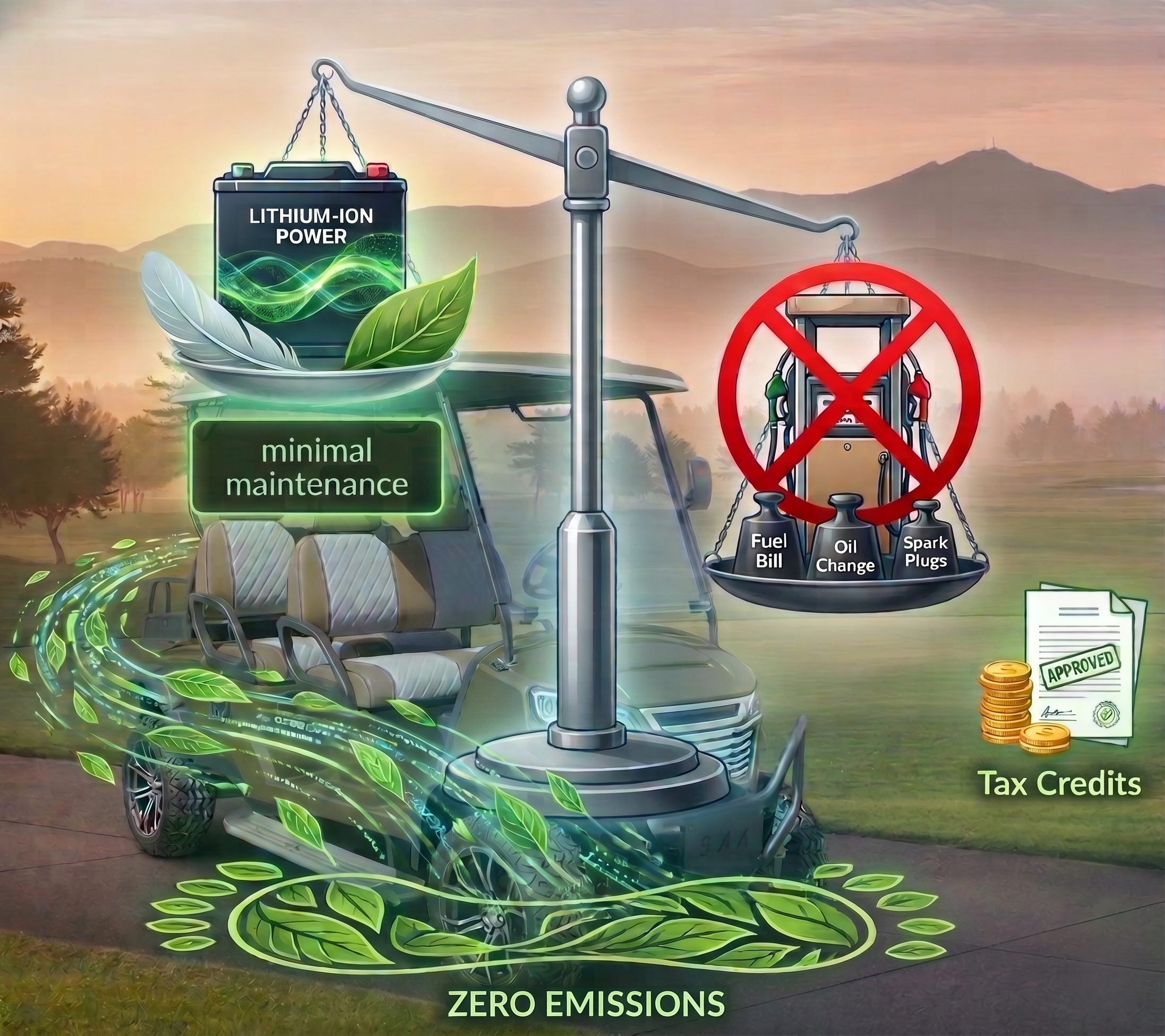
Consider a fifteen-year ownership window for two carts in typical community use. The lead-acid path absorbs roughly $6,000 in battery replacements, $4,500 in routine maintenance, and $3,000 in electricity, with about $1,000 in residual resale value at the end. The lithium path is leaner across the board: roughly $2,000 in a single battery replacement (or zero), $2,500 in maintenance, the same $3,000 in electricity, and about $5,500 in resale value at year fifteen. Net result: the lithium owner keeps roughly $6,000 across the fifteen-year horizon compared to the lead-acid path — before any incentives are applied, and before counting the quieter, cleaner experience of running the cart for those fifteen years. Apply available rebates and credits and that figure typically climbs higher.
How to build your own TCO model
You do not need spreadsheet skills. You need six numbers: battery replacement cost and frequency, annual maintenance, annual electricity, available incentives, estimated resale at your planned exit year, and the years you intend to own the cart. Multiply where appropriate, subtract resale and incentives, and divide by years owned to get a per-year cost of ownership. That number — cost per year — is the right one to put next to brand names when you compare. We find that most buyers who run this exercise change their shortlist within an hour.
The conscious calculation
Total cost of ownership is also where sustainability and economics finally align. A lithium cart that lasts fifteen years prevents three lead-acid battery disposals, hundreds of pounds of maintenance waste, and the embodied energy of a replacement cart you never had to buy. The cart runs silently. It releases no emissions in the neighborhood it moves through. The trees behind the fairway, the birds at first light, the neighbor sleeping in on a Saturday morning — all of them notice the difference, even if no one names it.
For many owners, that quiet daily fact — that the cart in the garage is collaborating with the world around it rather than wearing it down — is its own form of return. It is not on the spreadsheet, but it is real, and it compounds the way the savings compound. Choose for the long arc, and the math takes care of itself. Choose for the mindful arc, and the days take care of themselves. That's what we call holistic satisfaction.
Embrace a Journey of Empowered Ownership
A purposeful approach to a major purchase transcends the transaction itself; it aligns with a lifestyle where every decision contributes to a broader vision of growth, longevity, and quiet stewardship of the resources that pass through your life. A cart you keep for fifteen years is not only a financial decision — it is a small but real statement about how you intend to live with the things you own, and the kind of presence you want to keep on the landscape around you.
At Conscious Golfer, we believe in a philosophy of intentional choices that empower and facilitate mastery — over your game, over your home, and over the long arc of ownership. As you walk your own buyer’s journey, remember that it is the cumulative effect of aligned and thoughtful decisions that creates a life lived on purpose, in collaboration with the world it moves through. Buy once, well. The math agrees, the planet thanks you, and the days on the other side of the decision tend to feel a little quieter, a little lighter, and a little more your own.
Happy golfing!
For more insightful content about conscious golfing and living intentionally, continue exploring Conscious Golfer.